
Amino Spiking Explained: How to Spot Low-Quality Protein Powder Before You Buy (2026 Guide)
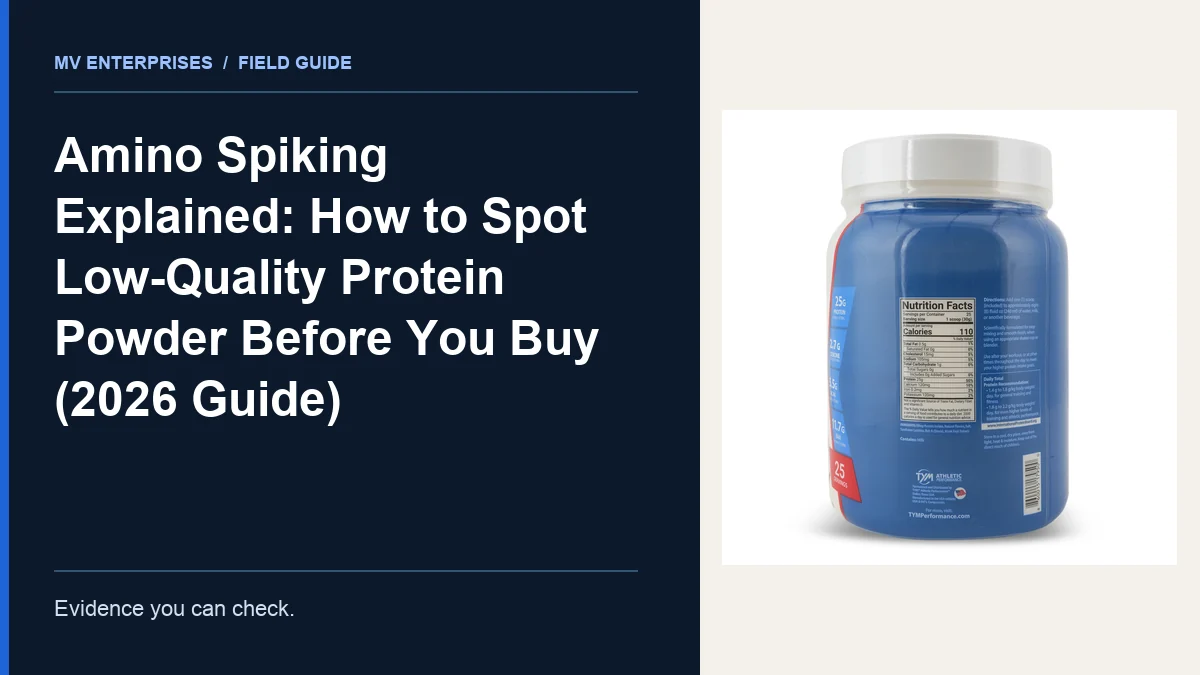
Quick answer: amino spiking — also called protein spiking or nitrogen spiking — is when manufacturers add cheap free-form amino acids like glycine, taurine, or creatine to protein powder to push up the measured protein number on the label. The actual amount of real, muscle-building protein you get per scoop ends up being far lower than what is printed on the tub.
Introduction
Have you ever flipped a protein tub around and actually read through the ingredient list? Most people scan the front label, see a big protein number, and drop it in the cart. That habit is costing a lot of gym-goers both money and results.
Here is something most supplement articles skip over: not every protein powder that lists amino acids like glycine or taurine on the label is a bad product. In plenty of cases, those ingredients are added for real reasons — better recovery, improved hydration, or a more complete nutritional profile. Some brands genuinely do this right.
The actual problem is not the ingredients themselves. The problem is when those cheap amino acids are used to make the protein number look bigger than it really is — and the brand says nothing about it.
Picking a protein powder that delivers honest nutritional value in every scoop is harder than it should be. This guide breaks down what amino spiking actually is, why some manufacturers do it, how to catch it on a label, and what a genuinely clean product looks like.
What is amino spiking?
Amino spiking is when cheap, individual amino acids get added to a protein supplement to push the measured protein number higher — without the product actually delivering more complete, usable protein.
The terms protein spiking and nitrogen spiking mean the same thing. Protein content in supplements has traditionally been measured using something called the Kjeldahl method — a test that estimates protein by measuring the total nitrogen in a sample. The problem is that the test cannot tell the difference between nitrogen that came from high-quality, complete protein and nitrogen that came from a handful of cheap individual amino acids. Both show up the same way.
Manufacturers who spike their products know this. They add low-cost amino acids like glycine or taurine, the nitrogen reading goes up, and the protein number on the label goes up with it — even though what you are actually getting per scoop has not changed in any meaningful way.
Here is a practical example: you buy a protein powder with 25 grams declared per scoop. Sounds good. But if that product is amino spiked, the real amount of complete protein you are getting could be as low as 10 to 12 grams. That is less than half of what the label tells you.
Why consumers should care
Amino spiking is not a mistake. Brands that do it know exactly what they are doing. High-quality whey protein, especially whey isolate, is genuinely expensive to source and manufacture. Some manufacturers, rather than absorbing those costs or being transparent about them, have found a cheaper way to keep their labels looking competitive.
The calculation is simple: swap out a portion of the expensive whey for cheap individual amino acids, keep the declared protein number the same, and make more money per tub.
When the protein number on a label does not reflect what is actually in the product, the gap shows up in your results:
- You may be getting fewer essential amino acids per serving than you think.
- You are paying for a protein level you are not receiving.
- Comparing products across brands becomes almost meaningless if the declared numbers cannot be trusted.
- Your overall protein intake may be consistently lower than you believe.
The amino acids most commonly used for spiking
None of the amino acids below are harmful in themselves. The issue is not that they exist in a formula — it is whether a brand is using them honestly or using them to pad numbers.
- Glycine — a non-essential amino acid, one of the cheapest available in bulk. Contains nitrogen so inflates protein readings. Does nothing for muscle growth on its own.
- Taurine — supports hydration and electrolyte balance, but is not used by the body to build muscle protein. Seeing taurine in a protein powder is not automatically a problem — but if it appears high on the ingredient list with no explanation, that is worth a second look.
- Arginine — common in pre-workout products. Does not belong in a protein supplement as a nitrogen source.
- Creatine — technically not an amino acid but nitrogen-containing, with genuine benefits for strength and performance. The concern is when it appears to be silently folded into the total protein gram figure.
- Glutamine — supports gut health and immune function. In large undisclosed amounts, it can contribute to an inflated nitrogen reading without adding real muscle-building value.
Added amino acids are not always a problem
Reputable brands add amino acids to protein powders for legitimate reasons. What separates these brands from the ones cutting corners is how openly they communicate what they have done and why. Before writing off a product, ask:
- Is the primary protein source clearly identified and listed first?
- Does the brand explain why these extra amino acids are in the formula?
- Has the product been tested and certified by an independent third party?
- Is the label easy to read and specific about what is in each serving?
Amino spiking vs amino fortification: know the difference
Amino fortification means a manufacturer has added specific amino acids for a real nutritional or performance purpose, and they say so on the label. Those amino acids are listed separately and are not folded into the total protein gram claim.
Amino spiking means free-form amino acids have been added with the primary goal of inflating the measured protein number. This either goes undisclosed or the amino acids are quietly counted as part of the total protein figure.
| Amino fortification | Amino spiking | |
|---|---|---|
| Purpose | Genuine nutritional benefit | Inflate the protein measurement |
| Disclosed | Yes — clearly stated | Rarely — usually hidden |
| Counted as protein | No — listed separately | Yes — counted without disclosure |
| What it means for you | Neutral or positive | You get less real protein than declared |
7 warning signs you're looking at an amino-spiked protein powder
- 1. The price seems way too low — good whey isolate costs money to produce. When a brand is selling a 5-pound tub for the same price a competitor charges for 2 pounds, something in that formula has been cheapened.
- 2. Free-form amino acids appear near the top of the list — ingredients are listed from highest to lowest quantity by weight. If individual amino acids like glycine, taurine, or glutamine appear before the halfway point, they are present in significant amounts relative to the actual protein content.
- 3. Amino acids listed with no reason given — a brand that adds ingredients for good reasons will say so. A brand that adds them to pad numbers usually says nothing at all.
- 4. "Proprietary blend" with no breakdown — this makes it impossible to verify how much of the declared protein comes from complete whey versus cheaper filler amino acids.
- 5. Leucine content does not add up — real whey protein contains around 11% leucine, roughly 2.7g of leucine per 25g of declared protein. If the leucine content is sitting well below 2.5g per 25g, something is off with the protein quality.
- 6. No amino acid profile published anywhere — any brand confident in what is inside their tub will publish a full amino acid breakdown.
- 7. Fillers like maltodextrin or corn syrup solids are high on the list — these are cheap carbohydrate fillers. When either appears near the top of an ingredient list in a protein powder, the formula has been padded with low-value bulk.
How to check if a protein powder is clean
Start by understanding what third-party certified actually means — then work through these four checks:
- Look for independent third-party testing — organisations like NSF Certified for Sport and Informed Sport test products with no financial stake in the outcome. Our explainer on what Informed Sport certification covers goes deeper.
- Check whether advanced testing methods were used — HPLC, mass spectrometry, and IR spectrum analysis can distinguish between complete protein and free-form amino acid additions.
- Contact the brand and ask directly — a brand that stands behind its product will answer questions about sourcing, certifications, and batch test results without hesitation.
- Run a quick protein-to-serving-weight check — for a clean whey protein powder, protein should account for roughly 70–85% of the serving weight.
Is amino spiking actually illegal?
No. In most countries, amino spiking is not illegal as long as all ingredients are somewhere on the label and the brand does not make an outright false claim. In markets like India and the United States, the supplement industry operates with limited pre-market oversight. Consumer awareness is growing — third-party certification is becoming an expected baseline rather than a bonus feature.
What genuinely good protein powder looks like
- Whey isolate or concentrate listed as the first ingredient.
- A full amino acid profile published on the packaging or brand website.
- Third-party certification from a recognised, independent testing organisation.
- Leucine content that lines up with natural whey — around 11% of total protein per serving.
- No proprietary blends that obscure ingredient amounts.
- Clear explanation of any additional amino acids in the formula.
Quick buyer's checklist
- Is whey isolate or concentrate listed as the first ingredient?
- Does the ingredient list read cleanly without unexplained additions?
- Does the brand explain why any extra amino acids are in the formula?
- Is independent third-party testing available and easy to verify?
- Are quality certifications named on the label or website?
- Can you request batch test results if needed?
- Does the brand have a real, verifiable track record?
- Does the price make sense for the ingredients declared?
- Is a complete amino acid profile published somewhere?
- Does the leucine content line up with genuine whey — roughly 2.5g or more per 25g of protein?
How ProTYM handles this
ProTYM Whey Isolate, imported by MV Enterprises, starts with whey isolate as its declared and primary protein source, listed first, with no ambiguity about what you are buying.
- The protein source is named clearly — whey isolate is the primary ingredient, stated upfront.
- No proprietary blend hiding the formula — every ingredient is listed individually with quantities disclosed.
- Full amino acid profile published — buyers can verify that the leucine and essential amino acid content lines up with genuine, high-quality whey isolate.
- Honest ingredient labelling — if additional ingredients are included, they are named and their purpose is stated.
You can also verify ProTYM's certification and batch documentation yourself before you buy.
For the science behind the leucine figures above, and why the leucine threshold is such a useful label check, read our leucine guide. If you are new to protein powder, start with whey protein for beginners, and use our step-by-step guide on how to verify a protein supplement before you buy.
FAQs
What is amino spiking in protein powder? Amino spiking is when cheap, individual amino acids like glycine or taurine are added to a protein supplement to make the measured protein number look higher. The product delivers less complete, muscle-building protein per scoop than the label suggests.
Is amino spiking bad for your health? Not directly harmful in most cases — the bigger concern is consistently getting less real protein than you paid for.
Can whey isolate be amino spiked? Yes. The protein type listed on the front of a tub does not guarantee the formula is clean. A product marketed as whey isolate can still contain added free-form amino acids. Reading the full ingredient list and checking leucine content matters more than the headline claim.
How do I tell if my protein powder is amino spiked? Look for free-form amino acids listed high in the ingredients with no explanation, leucine content below 2.5g per 25g of protein, no published amino acid profile, and no independent third-party certification.
What is the difference between amino spiking and amino fortification? Amino fortification is when a brand adds amino acids for a real purpose, states this on the label, and counts them separately from the total protein figure. Amino spiking is when the same amino acids are added to inflate the protein number with little or no disclosure.
This article is general educational information, not medical or dietary advice. ProTYM is imported and distributed in India by MV Enterprises.