
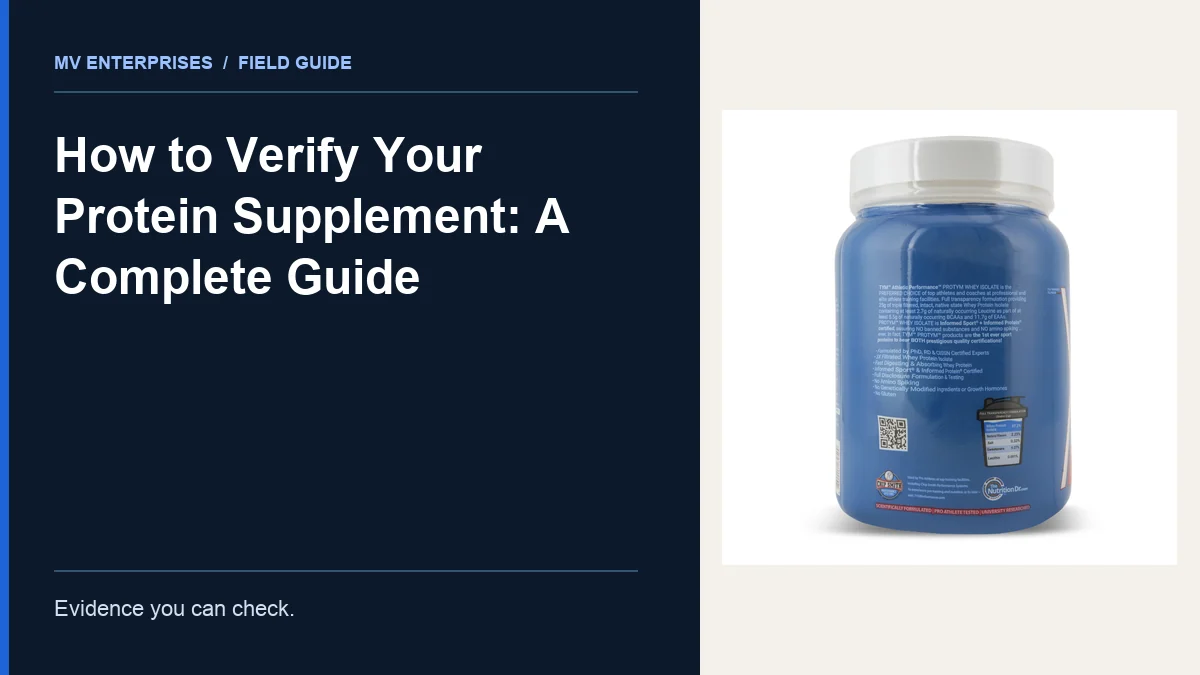
If you are looking at how to check protein supplements in India then don't just depend on the packaging. Before you buy a tub of protein powder, take a few minutes to check the details.
The best part? You don't need a chemistry degree to do this. What actually matters is knowing what to look for, where to look for it, and what each piece of information is really telling you.
This guide walks through the process step by step, using ProTYM Whey Isolate as a real-world example so you can see how this verification actually plays out.
1. Check the manufacturer and Indian importer
Start by actually reading the tub or the product page carefully — not just skimming it. Look for:
- Product name
- Manufacturer
- Indian importer or marketer
- Country of origin
- Net quantity
- Ingredients
- Nutrition information
- Batch or lot number
- Manufacturing and expiry/best-before information
- FSSAI licence details, where applicable
ProTYM Whey Isolate identifies TYM Athletic Performance as its US manufacturer and MV Enterprises as its Indian importer and distributor. The brand also publishes its Indian regulatory and importer information on its verification page. This gives a buyer a starting point for checking the product's supply chain rather than simply relying on the product name.
2. Customer-care information
If you're buying an imported protein supplement, keep in mind that the manufacturer and the Indian importer are often two different companies. That distinction matters more than you might think — the manufacturer tells you where the product was actually made, while the importer is the business responsible for getting it into India.
ProTYM Whey Isolate names TYM Athletic Performance as its US manufacturer, with MV Enterprises listed as its Indian importer and distributor. The brand also puts its Indian regulatory and importer details right on its verification page.
3. Verify the FSSAI licence
Just because an FSSAI number shows up on a website or label doesn't mean you should assume it's genuine. You can independently check any FSSAI licence or registration through the official FoSCoS system. How to check it:
- Find the FSSAI licence or registration number.
- Head to the official FoSCoS verification page.
- Type in the number.
- Check the business name and licence status.
- Compare this against the manufacturer, importer, or business named on the product.
Note: an active FSSAI licence is an important box to tick, but it doesn't automatically prove every quality, performance, certification, or authenticity claim made about a protein supplement.
MV Enterprises features its FSSAI Central Licence number — 10825999000521 — on its authenticity page. That gives a buyer something solid to check against official FSSAI records.
4. Check certification claims independently
Spotting a certification logo on a protein tub isn't the same as actually verifying that certification. Go straight to that certification body's own database and search for the product yourself.
For instance, if a product claims Informed Sport certification, check it through the Informed Sport programme directly — don't just trust the logo on the packaging. Simple process to follow:
- Note down the exact product name.
- Search the certification body's database.
- Ensure the details match what's on the package.
Want to understand how this actually works? Check out our guide to Informed Sport certification. And if you're trying to compare different types of independent testing, read our guide to third-party certified protein.
5. Find the batch or lot number
Look at the batch or lot number on your protein tub. You'll usually find it near the manufacturing date, best-before date, or barcode, or on the bottom of the container or the side or back label.
This matters because protein supplements are made in separate production runs. A Certificate of Analysis for one batch shouldn't be treated as evidence for a completely different one.
6. Scan the QR code — but look at where it takes you
A QR code can make verification a lot easier, but the QR code itself isn't proof of anything — what matters is where it leads you. Once you've scanned it, ask yourself:
- Does it identify the product?
- Does it identify the batch?
- Does the information actually match your tub?
- Does it give you access to real documentation?
- Does it point to a credible source?
A QR code that simply opens the brand's homepage is not doing the same job as a QR code that links a specific product to batch-level documentation.
ProTYM uses a batch-specific QR code that connects the product directly to its Certificate of Analysis. The verification chain looks like this: Product → QR code → Batch → Certificate → Supporting lab information.
7. Match the batch-specific Certificate of Analysis
A Certificate of Analysis (COA) is essentially a laboratory report for a particular product or lot. Actually look at what's in it:
- Batch number: does it match what's on your tub?
- Test laboratory: clearly identifiable?
- Report or reference number: can you locate this document yourself?
- Test date: what date was the test performed?
- Scope: what was examined?
- Results: are real numbers provided, not just pass/fail?
- Units and limits: are the values and specifications well defined?
8. Read the label carefully
Take a look at the serving size, protein per serving, calories, ingredient list, sweeteners, flavouring, allergen information, net quantity, manufacturer/importer information, batch number, and manufacturing and expiry/best-before dates.
For instance: "25g protein per serving" is a nutritional claim. "Informed Sport certified" is a certification claim. "Imported from the USA" is a supply-chain claim. Don't judge a protein powder purely by how many bold claims are plastered across the front.
9. Make sure everything matches
Once you've checked each piece individually, put them all together and see if they connect. You should be able to trace: product label → manufacturer → Indian importer → FSSAI credentials → certification claim → batch number → QR verification → batch-specific COA.
If something doesn't add up, don't just shrug it off. None of these automatically mean the product is fake, but they're reasons to pause and dig deeper before buying.
7 red flags to watch for
- The manufacturer isn't clearly named.
- The Indian importer isn't disclosed for an imported product.
- The FSSAI number can't be independently verified.
- The certification logo doesn't show up in the certifier's records.
- The QR code just opens a homepage.
- The COA doesn't match your batch.
- The seller can't answer basic questions.
The bottom line
Don't judge a protein supplement by how many claims it makes. Judge it by how easily those claims can actually be verified.
ProTYM's verification system brings together product details, Indian importer information, FSSAI credentials, certification data, and batch-level documentation all in one place.
Want to see how this works in practice? Head over to the ProTYM authenticity page and go through the information yourself.
Once you know how to verify a product, the next questions are how much protein you need and where a supplement fits. See our protein intake guide, our guide to whey protein for beginners, and our list of high-protein Indian foods.
FAQs
How can I tell if a protein supplement is genuine in India? Look at the manufacturer and importer details, check that the FSSAI credentials actually hold up, confirm any certification claims through the official registries, and make sure the batch number on your tub matches the QR-linked documentation or COA.
Does having an FSSAI licence mean a protein supplement is genuine? No. An FSSAI licence confirms that the food business has the right regulatory credentials in India — it doesn't automatically vouch for the product's quality, certifications, or authenticity claims.
How do I check if a protein supplement's COA is legit? See if the COA clearly names the testing lab, includes a report number, shows the test date, and specifies a batch number. Make sure that batch number actually matches the tub you're holding.
Does scanning the QR code on a protein tub prove it's authentic? Not by itself. A QR code is only as useful as where it takes you. If it links to verifiable, batch-specific documentation, that's a good sign. But if it just opens the brand's homepage, you haven't really verified much.
How do I verify a certification claim on a protein supplement? Don't just trust the logo — search for the product directly in the certification body's official database and confirm the details match what's printed on the packaging.
This article is general educational information, not medical or dietary advice. ProTYM is imported and distributed in India by MV Enterprises.