
Leucine and Muscle Protein Synthesis: Why Your Protein's Amino Acid Profile Matters
If you've been paying attention to protein for a while, you already know that "25g protein per serving" isn't the whole story. Once you start digging deeper, leucine comes up again and again.
Leucine is an essential amino acid that regulates muscle protein synthesis (MPS). It switches on signalling pathways tied to MPS, mainly through the mTORC1 pathway. But leucine alone won't build muscle. Your body still needs the other essential amino acids as raw material, plus resistance training and enough total protein to make any of this matter.
What Is Leucine?
Leucine is one of nine essential amino acids (EAAs) — your body can't make enough of it on its own, so it has to come from food. It also belongs to the branched-chain amino acid (BCAA) group, along with isoleucine and valine.
What sets leucine apart is its job as a nutritional trigger. When protein breaks down into amino acids after a meal, leucine helps switch on mTORC1 (mechanistic target of rapamycin complex 1) — a key driver behind muscle protein synthesis.
Here's a simpler way to think about it:
- Leucine → sends the signal
- Other EAAs → supply the raw material
- Resistance training → creates the demand
- Total protein intake → keeps the whole process running
How Does Leucine Trigger Muscle Protein Synthesis?
When you eat a protein-rich meal or drink a shake, your body breaks that protein down into amino acids. Leucine is one of the amino acids your body uses to detect this incoming supply and kick off mTORC1 signalling. Resistance training makes your muscles more responsive to amino acids in the first place.
Process in order: Protein → Digestion → Amino acids released → Leucine triggers anabolic signalling → mTORC1 activates → Muscle protein synthesis rises.
A spike in muscle protein synthesis is a short-term response. It's not the same as long-term muscle growth. Real changes in muscle mass come from consistent training, proper nutrition, and recovery, repeated over weeks and months.
What Is the Leucine Threshold?
The "leucine threshold" refers to the amount of leucine in a meal that's enough to trigger a strong anabolic response. Sports nutrition research generally points to protein servings of 20–40g providing roughly 700–3,000mg of leucine, along with a full spread of essential amino acids, as being effective for this purpose.
Don't treat this number as fixed. The actual response depends on: total protein consumed, protein quality, how much leucine and EAAs are available, whether you've trained recently, your age, your training experience, and what else you've eaten that day.
How to Check Leucine Content in a Protein Supplement
- 1. Check the Serving Size — Always compare products using the same serving size.
- 2. Check Protein Per Serving — Serving weight and protein weight are two separate figures.
- 3. Find the Leucine Content — Look for an amino acid breakdown on the label. For example: Leucine — 2.7g per serving.
- 4. Look at Total Essential Amino Acids — A high leucine count paired with a weak overall EAA profile isn't a complete picture. A leucine figure that doesn't line up with the total protein can also be a sign of amino spiking in protein supplements.
- 5. Consider the Protein Source — Whey naturally delivers strong amounts of both EAAs and leucine. See whey isolate vs whey concentrate for how the two forms of whey differ.
- 6. Look Beyond the Amino Acid Profile — Also check ingredient list, protein content per serving, serving size, manufacturing standards, third-party testing and certification, and whether the brand's claims can actually be verified. Our guide to Informed Sport certification explains what to look for.
Does More Leucine Always Mean More Muscle Protein Synthesis?
No. Once you've hit a strong enough signal, adding more leucine won't necessarily push the response further. What matters at that point is whether you have enough of the other essential amino acids on hand. This is exactly why a complete protein source beats loading up on isolated leucine.
Leucine and Total Daily Protein: The Bigger Picture
What actually matters more is your total daily protein intake. For people who train regularly, sports nutrition guidelines typically recommend 1.4–2.0g of protein per kg of bodyweight per day. Work out your own number with our protein intake guide for an Indian diet.
A large meta-analysis of resistance training studies found that protein supplementation supports gains in fat-free mass and strength, though the benefits taper off past roughly 1.6g/kg/day under the conditions tested.
Here's a more useful order of priorities:
- Enough total protein across the day
- Consistent resistance training
- Protein spread reasonably across meals
- Quality protein sources
- Leucine and EAA content
A Simple Checklist for Comparing Protein Supplements
Numbers to check: How much actual protein is in each serving? How much leucine does that protein deliver? Is there a solid amount of total essential amino acids?
Protein source: What type of protein is it? Are you comparing products on the same serving basis?
What else is in there? Can any quality or testing claims be verified?
The Bottom Line
Leucine plays a real role in regulating muscle protein synthesis, but it shouldn't be judged in isolation. The goal isn't to hunt down whichever protein has the highest leucine number — it's to pick a quality protein that delivers enough total protein, solid leucine content, and a well-rounded spread of essential amino acids.
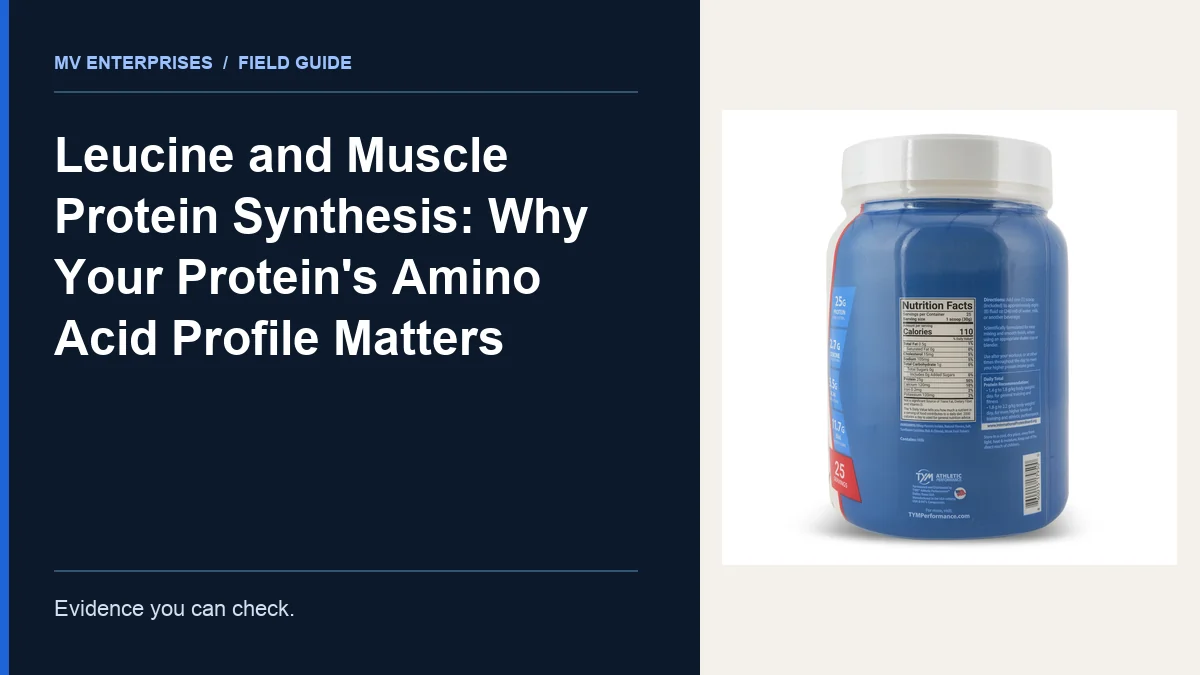
For instance, ProTYM Whey Isolate delivers 25g protein and 2.7g leucine per 30g serving, along with 11.7g of EAAs and 5.5g of BCAAs.
Frequently Asked Questions
How much leucine is needed to stimulate muscle protein synthesis? A commonly cited range is 700–3,000mg of leucine per protein feeding, alongside a solid dose of high-quality protein and a balanced spread of essential amino acids.
Is 3g of leucine per meal necessary? Not strictly. That 3g figure gets repeated a lot, but it's not a hard cutoff.
Does more leucine mean more muscle growth? Not automatically. Actual muscle growth over time comes down to training, total protein intake, adequate EAAs, and recovery.
How do I check leucine content in protein powder? Check the manufacturer's amino acid profile for leucine per serving, weighed against total protein, total EAAs, the protein source, and the serving size.
Is leucine more important than total protein intake? No. Leucine's signalling role matters, but it doesn't replace the need for enough total protein.
This article is general educational information, not medical or dietary advice. ProTYM is imported and distributed in India by MV Enterprises.